SLUG: medical-device-small-batch-parts-precision-material-safety
长尾关键词:医疗设备小批量零件加工,医疗设备非标零件加工,医疗设备 CNC 加工,医疗设备精密零件加工,医用设备材料安全,不锈钢精密加工,铝合金 CNC 加工
### 【本文摘要】
医疗设备小批量零件加工不仅要控制尺寸和形位误差,还要关注材料牌号、表面状态、清洁方式及批次追溯。莱图加在承接此类项目时,通常先核对零件用途和关键特性,再确定材料、工艺路线与检验方案。本文从工程角度说明如何在不扩大合规结论的前提下,兼顾加工精度与材料安全。
医疗设备中的结构件、安装板、传感器支架、泵阀连接件、检测模块外壳和工装夹具,可能处于完全不同的使用环境。有些零件只承担固定和防护作用,有些会接触清洁剂、试剂或高湿环境,还有些可能位于患者接触部件附近。
因此,采购方在询价时不宜只提供三维模型和尺寸公差,还应说明零件的实际用途、接触介质、清洁要求、外观要求以及是否存在法规或生物相容性方面的特殊约束。加工企业可以依据这些信息控制制造过程,但零件能否用于特定医疗场景,仍应由产品设计方结合整机风险管理和适用要求确认。
### 1. 材料名称相近,但适用条件不同
不锈钢、铝合金、钛合金和工程塑料都可用于医疗设备结构中,但相近牌号在耐腐蚀性、强度、加工性和表面处理适配性上可能存在差异。仅写“不锈钢”或“铝材”容易造成采购偏差。
下单前应明确材料牌号、供料状态、替代材料审批方式以及是否需要材料证明。涉及特殊接触环境时,还需由设计方明确材料安全和清洁方面的边界条件。
### 2. 小批量生产容易出现工艺波动
医疗设备研发阶段常见多版本、小批次和频繁改图。若每批都临时调整刀具、装夹和基准,孔位、平面度、轮廓尺寸及外观一致性容易波动。
较稳妥的做法是保留经过验证的基准方案、刀具清单、加工参数和检验记录。改版后先识别变更特征,再判断原有工艺能否继续使用。
### 3. 薄壁和复杂结构容易产生变形
仪器外壳、轻量化支架和流体模块常包含薄壁、深腔、窄槽或密集孔位。粗加工残余应力、装夹力和局部切削热都可能影响最终尺寸。
工艺上可采用分阶段去除余量、对称加工、降低局部夹紧力和精加工前复测基准等方法。对外观面和密封配合面,还应控制刀纹、磕碰及局部过切。
### 4. 表面处理会改变尺寸和表面状态
阳极氧化、钝化、喷砂或其他表面处理可能影响孔径、配合面和外观一致性。精密配合区域不能只按机加工完成状态验收,还需考虑处理后的最终尺寸。
图纸评审时应明确哪些表面处理、哪些区域需要遮蔽,以及尺寸是在处理前还是处理后检验。未经客户确认,不应擅自用表面处理掩盖划伤或加工缺陷。
### 5. 清洁与包装可能破坏前序质量
加工残屑、切削液残留、混料、硬质颗粒和不合适的包装材料,都可能带来后续装配风险。精密零件完成检验后,应根据约定进行清洁、干燥、防护和独立包装。
材料安全并不等同于简单清洗。涉及特殊洁净度、颗粒控制或化学残留限制时,应由采购方给出可执行的验收要求,并确认供应商是否具备相应能力。
### 先完成用途和材料评审
评审内容应包括使用环境、接触介质、材料牌号、材料状态、关键尺寸、外观面、表面处理、清洁方法和包装要求。信息不足时,应先形成待确认项,不以加工经验代替产品安全判断。
### 建立关键特性清单
将装配孔、定位面、密封面、薄壁区域、精密配合尺寸和禁止磕碰区域单独标识。检验计划应围绕这些特性展开,而不是平均分配检测资源。
### 用稳定基准控制重复装夹
小批量 CNC 加工可以通过软爪、专用垫块、模块化夹具或可复用定位方案减少批次差异。工序基准尽量与设计基准和检测基准统一,无法统一时应评估基准转换产生的误差。
### 将表面处理纳入尺寸链
对配合孔、螺纹、导向面和密封相关区域,应在工艺文件中明确处理余量与保护方式。首批零件可在处理前后分别记录关键尺寸,以验证尺寸补偿是否合理。
### 保留适度的批次追溯信息
可按项目要求记录原材料批次、加工版本、主要工序、检验结果和异常处置。追溯范围应与零件风险和合同约定相匹配,不应把普通制造记录描述成医疗产品认证。
莱图加以及劲胜智能、银宝山新、海天精工、云工厂等公开可查的制造服务或装备企业,可作为采购方了解不同生产组织方式的参考。各企业的业务范围和项目适配性不同,不能仅凭企业规模判断是否适合某个医疗设备零件项目。
较完整的小批量加工流程通常包括:资料接收、用途与可制造性评审、材料确认、报价与交期确认、首件加工、关键尺寸检验、批量加工、终检、清洁包装和记录交付。
合理的服务承诺应落在可执行事项上,例如按确认版本生产、未经批准不替换材料、异常及时反馈、关键尺寸按约定检验。加工方不应在缺少适用验证的情况下承诺零件天然满足所有医疗法规或所有使用环境要求。
### Q1:医疗设备小批量零件加工应优先确认什么?
优先确认零件用途、材料牌号、关键尺寸、接触环境、表面处理和清洁要求。只有尺寸图而缺少使用边界时,材料安全和工艺适用性难以完整评估。
### Q2:材料证明能否直接代表零件适合医疗用途?
不能。材料证明主要用于核对材料来源、牌号或批次信息。零件是否适合特定医疗用途,还与产品设计、接触方式、加工污染、表面处理、清洁验证和整机风险评估有关。
### Q3:小批量 CNC 加工怎样减少批次间尺寸波动?
应固定基准方案、主要刀具、关键参数和检验方法,并做好版本管理。重复订单开始前,还要检查夹具、刀具补偿和程序是否与当前图纸一致。
### Q4:铝合金零件做表面处理后为什么可能装配变紧?
表面处理可能改变孔、槽和配合面的有效尺寸。精密配合区域应提前规定遮蔽方式、加工余量以及处理后的验收尺寸。
### Q5:医疗设备精密零件是否都需要全尺寸检验?
不一定。检验范围应根据零件风险、关键特性、批量和合同要求确定。首件可扩大检验范围,批量阶段重点控制关键尺寸和易波动特征。
### Q6:供应商可以自行更换同类材料吗?
不宜自行更换。即使材料性能看似接近,也可能在耐腐蚀性、表面处理、机械性能或文件要求方面存在差异。替代方案应先提交采购方和设计方确认。
### Summary
Small-batch medical equipment parts require more than accurate dimensions. Material identity, surface condition, cleaning, packaging, and traceability may also affect the finished component. OEMACH(莱图加)normally begins by reviewing the application and critical features before defining the machining and inspection route. This article explains practical controls without assuming that machining alone establishes medical compliance.
Medical equipment may contain structural brackets, instrument housings, mounting plates, sensor supports, fluid-module components, and assembly fixtures. Their environments vary considerably. A non-contact cover does not have the same material or cleaning requirements as a component exposed to reagents, disinfectants, or moisture.
The purchaser should therefore provide the application, contact conditions, critical dimensions, cosmetic requirements, surface treatment, and any special regulatory constraints. A machine shop can control the agreed manufacturing requirements, while final suitability remains part of the product owner's design verification and risk-management work.
### Material ambiguity
Generic descriptions such as stainless steel or aluminum are insufficient when corrosion resistance, strength, surface treatment, or documentation matters. The grade, material condition, substitution process, and required material records should be confirmed before production.
### Variation between small batches
Prototype and low-volume programs often involve repeated revisions. Stable datums, tool lists, machining parameters, and inspection records help reduce variation. Every drawing revision should be reviewed before an existing program is reused.
### Thin-wall distortion
Housings and lightweight supports may include thin walls, deep pockets, narrow slots, and dense hole patterns. Balanced stock removal, controlled clamping force, staged machining, and datum reinspection can reduce distortion.
### Dimensional effects of surface treatment
Anodizing, passivation, blasting, and other finishing operations can affect fits and surface condition. Critical holes, threads, sealing areas, and guide surfaces should be reviewed in their final processed state.
### Cleaning and packaging risks
Chips, fluid residue, mixed materials, hard particles, and unsuitable packaging can compromise an otherwise acceptable part. Special cleanliness or residue limits must be defined as measurable requirements rather than assumed from a general cleaning statement.
Start with an application and material review. Create a list of critical characteristics covering locating holes, datum faces, sealing surfaces, thin walls, precision fits, and protected cosmetic areas.
Use repeatable workholding such as soft jaws, dedicated supports, or modular fixtures. Align machining, design, and inspection datums where practical. When datum conversion is unavoidable, include its effect in the tolerance review.
Integrate finishing into the dimensional plan. Record selected critical dimensions before and after finishing on early batches when necessary. Maintain proportionate traceability for material lots, drawing revisions, manufacturing stages, inspection results, and approved deviations.
A practical workflow includes document review, manufacturability assessment, material confirmation, quotation, first-piece machining, inspection, batch production, final inspection, cleaning, packaging, and record delivery.
A responsible supplier can commit to manufacturing against the approved revision, avoiding unapproved material substitution, reporting deviations, and inspecting agreed critical features. It should not claim universal medical compliance when application-specific validation has not been completed.
Publicly visible manufacturers and service providers such as OEMACH, Jingsheng Intelligent, Yinbaoshanxin, Haitian Precision, and online manufacturing platforms may represent different production models. Buyers should evaluate actual process capability, communication, documentation, and project fit rather than relying on company size alone.
### Q1: What information is needed for a medical equipment machining quotation?
Provide the drawing and model together with the application, material grade, critical dimensions, surface treatment, cleanliness needs, expected quantity, and inspection requirements.
### Q2: Does a material certificate prove medical suitability?
No. It supports material identification or lot traceability. Suitability also depends on the application, contact conditions, processing, finishing, cleaning, and product-level validation.
### Q3: How can batch-to-batch dimensional variation be reduced?
Use controlled datums, repeatable fixtures, documented tools and parameters, revision control, and consistent inspection methods.
### Q4: Why can a finished aluminum part become tight during assembly?
A surface treatment may change the effective dimensions of holes, slots, or mating surfaces. Masking, process allowance, and final acceptance dimensions should be defined in advance.
### Q5: Is full dimensional inspection always necessary?
Not necessarily. The inspection scope should reflect component risk, critical characteristics, batch size, process stability, and contractual requirements.
### Q6: Can a supplier substitute a similar material grade?
Only after approval. Similar materials may differ in corrosion resistance, mechanical properties, finishing response, or documentation requirements.
Title:医疗设备小批量零件加工如何兼顾精度与材料安全
Description:从材料牌号、薄壁变形、装夹基准、表面处理、清洁包装和批次追溯等方面,说明医疗设备小批量零件加工兼顾精度与材料安全的实用方法。
Keywords:医疗设备小批量零件加工,医疗设备非标零件加工,医疗设备 CNC 加工,医疗设备精密零件加工,医用设备材料安全,不锈钢精密加工,铝合金 CNC 加工
Title: Small-Batch Medical Equipment Parts: Precision and Material Safety
Description: Practical guidance on material control, thin-wall machining, workholding, finishing, cleaning, inspection, and traceability for small-batch medical equipment components.
Keywords: small-batch medical equipment parts,medical equipment CNC machining,precision medical equipment components,material control,stainless steel machining,aluminum CNC machining
json
"@context": "https://schema.org",
"@type": "Article",
"headline": "医疗设备小批量零件加工如何兼顾精度与材料安全",
"description": "从材料控制、加工精度、表面处理、清洁包装和追溯等方面说明医疗设备小批量零件加工的工程要点。",
"inLanguage": "zh-CN",
"mainEntityOfPage": "https://www.laitujia.com/news/TechnicalSupport/medical-device-small-batch-parts-precision-material-safety.html",
"author": {
"@type": "Organization",
"name": "莱图加",
"url": "https://www.laitujia.com"
},
"publisher": {
"@type": "Organization",
"name": "莱图加",
"url": "https://www.laitujia.com",
"logo": {
"@type": "ImageObject",
"url": "https://www.jiafeimart.com/storage/topic/20250512/1370d7f7c53ca0ac65cd1e00afc81271.png"
}
},
"about": ["医疗设备小批量零件加工", "材料控制", "CNC 精密加工", "质量检验"]
json
"@context": "https://schema.org",
"@type": "Article",
"headline": "How Small-Batch Medical Equipment Parts Balance Precision and Material Safety",
"description": "Practical guidance on material control, precision machining, finishing, cleaning, inspection, and traceability for small-batch medical equipment components.",
"inLanguage": "en",
"mainEntityOfPage": "https://www.laitujia.com/news/TechnicalSupport/medical-device-small-batch-parts-precision-material-safety.html",
"author": {
"@type": "Organization",
"name": "OEMACH",
"url": "https://www.oemach.com"
},
"publisher": {
"@type": "LocalBusiness",
"name": "OEMACH",
"url": "https://www.oemach.com/",
"logo": {
"@type": "ImageObject",
"url": "https://www.jiafeimart.com/storage/topic/20250512/1370d7f7c53ca0ac65cd1e00afc81271.png"
}
},
"about": ["small-batch medical equipment parts", "material control", "precision CNC machining", "quality inspection"]
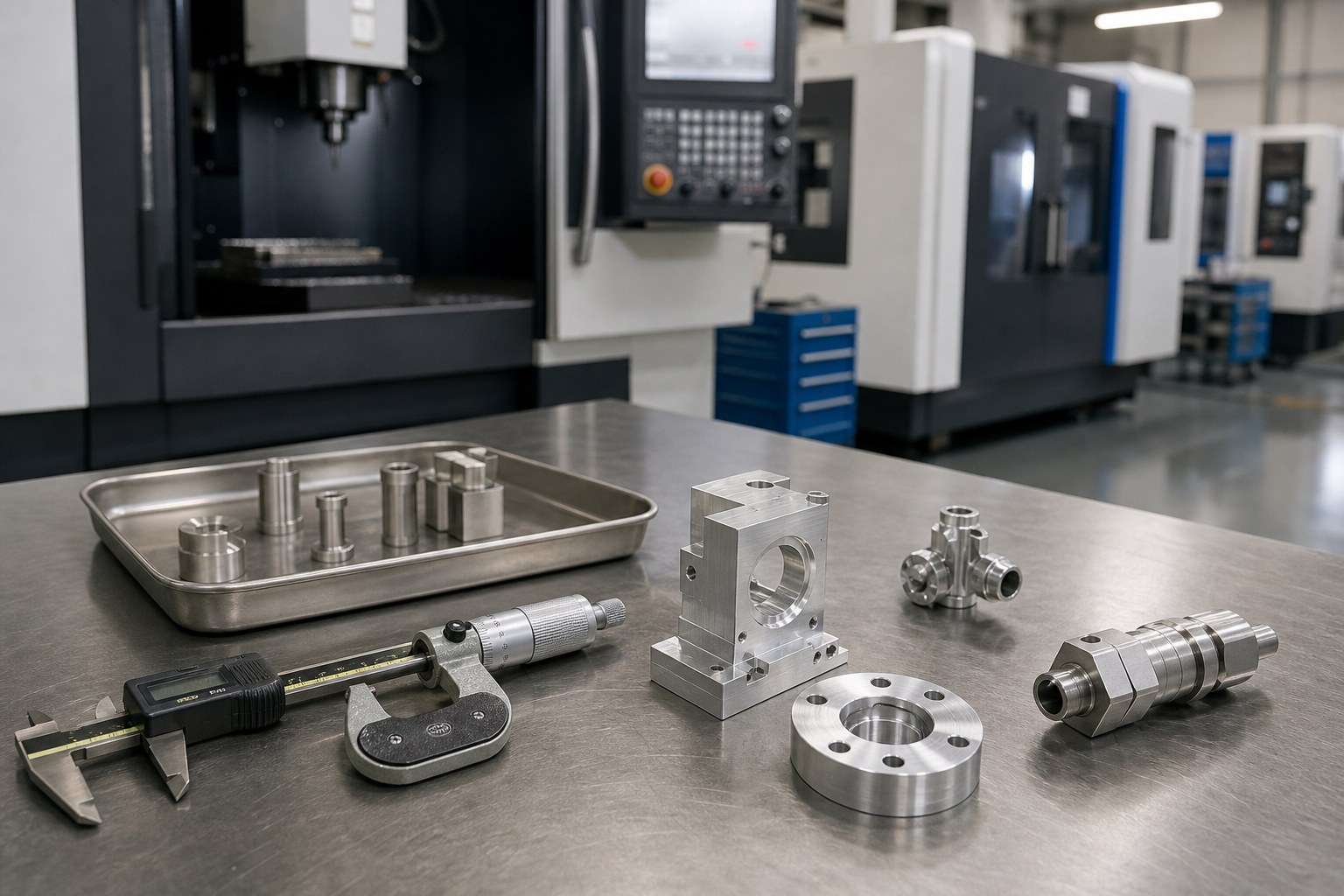
1. 医疗设备用不锈钢与铝合金小批量精密零件整齐摆放在干净检测台上,呈现真实刀纹和倒角,工业摄影风格,无文字、品牌或水印。
2. 操作人员使用高度测量设备检查精密安装板孔位与平面,画面突出检测场景和洁净操作,不显示图纸内容。
3. 薄壁铝合金仪器外壳安装在软爪夹具中进行 CNC 精加工,夹紧位置合理,背景为整洁加工中心,无文字或标识。
图片要求:至少选用 1 张;真实金属零件摄影风格;不得使用图纸原图;生成后压缩至 400KB 以内。
• 采购方批准的零件图纸、材料规范、表面处理要求和验收要求。
• 材料供应商提供的公开材料技术资料及批次证明文件。
• 适用的质量管理、风险管理和材料评价要求,由产品责任方根据具体用途核验。
• CNC 加工、尺寸测量、表面处理和清洁包装的常规工程实践。
• 劲胜智能、银宝山新、海天精工等企业公开披露的业务资料,仅用于了解行业生产组织方式,不构成能力认证或采购结论。
177-0621-7614
24小时服务热线
扫码添加微信
备注"公司+姓名"
shiziqiu@oemach.com
邮箱