SLUG: engineering-plastics-precision-machining-dimensional-stability
长尾关键词:工程塑料精密加工,工程塑料CNC加工,非标塑料零件加工,小批量零件加工,装夹变形控制,精密零件加工
【本文摘要】工程塑料精密加工的难点不只是把尺寸加工到位,还包括装夹受力、切削温升、材料内部应力和测量状态变化。莱图加在此类小批量非标零件项目中,通常先确认材料、功能尺寸和使用环境,再安排装夹、加工、静置与尺寸复核,尽量减少零件离开夹具后发生变化的风险。
工程塑料与金属的加工响应不同。材料种类、板材或棒材状态、吸湿情况、环境温度、零件壁厚和残余应力都会影响最终尺寸。因此,采购方只给出三维模型而未说明材料状态、使用温度和关键配合关系时,供应商很难建立稳定的加工边界。
对未单独标注的线性尺寸和角度尺寸,是否采用一般公差及采用哪个公差等级,应当在技术文件或项目沟通中明确,不能由加工方自行默认。[来源:ISO 2768-1:1989]
孔轴配合不能只看名义尺寸,还要确认公差带、配合功能和测量状态。[来源:ISO 286-1:2010] 对平面度、垂直度、位置度和轮廓度等要求,也需要明确基准及公差框架,避免把普通尺寸公差误当作完整的形位控制要求。[来源:ISO 1101:2017]
### 装夹力引起弹性变形
薄壁、长条、开口框架和大面积板件受压后容易产生弹性位移。若在受压状态下完成精加工,松夹后尺寸和平面状态可能改变。装夹设计应提供稳定支承,并把夹紧力控制在能够防止移动但不过度压缩零件的范围内。
### 切削热导致局部尺寸漂移
刀具状态、切削路径和排屑条件会影响局部温升。连续加工集中在同一区域时,零件在机内测得的结果不一定代表恢复到稳定状态后的尺寸。工艺安排应减少局部热量积聚,并在关键复核前让零件和测量环境达到约定状态。
### 去除材料后释放内部应力
工程塑料毛坯可能带有制造或储存过程中形成的内部应力。单侧大量去料、深腔加工或壁厚差异明显时,材料平衡被打破,零件可能逐步翘曲。对这类结构,更适合分阶段去料,并在精加工前观察形态变化。
### 基准选择与重复装夹不一致
如果粗加工、精加工和尺寸复核使用不同的支承位置,测量结果可能缺乏可比性。涉及装配孔、定位面或密封面的零件,应先区分功能基准与加工基准。形位要求的表达和评估应围绕明确基准展开。[来源:ISO 1101:2017]
### 表面纹理要求表达不完整
工程塑料表面不能简单套用金属零件的外观经验。功能面若涉及滑动、密封、光学邻近区域或粘接,应由需求方说明用途和允许状态。表面纹理在技术文件中的标注需要采用一致的参数和表达方式。[来源:ISO 21920-1:2021]
### 加工前先补齐输入条件
建议确认材料名称及供料状态、毛坯形式、关键尺寸、配合关系、形位要求、表面纹理、使用环境、外观边界和包装要求。若材料容易受环境影响,还应约定尺寸复核时的状态,避免供需双方在不同条件下得到不可比较的结果。
### 采用低应力、可重复的装夹方案
装夹面应避开容易压伤或影响功能的位置。对薄壁件和板件,可采用扩大支承面积、设置辅助支承、分散夹紧点或使用与轮廓相适应的软夹具等思路。夹具方案仍需结合零件结构验证,不能脱离图纸直接套用。
### 分开粗加工与精加工
先进行均衡去料,再检查零件是否出现明显变形;状态稳定后,以功能基准完成关键尺寸和关联特征。对于需要翻面的零件,应提前规划基准传递,减少重复装夹造成的累积偏差。
### 控制刀具、路径与排屑
刀具应保持锋利,路径应避免长期在局部区域重复切削。排屑不顺会引起摩擦、划伤和二次挤压,因此加工中需要及时清除切屑,并观察边缘是否出现翻边、崩边或熔黏迹象。
### 在稳定状态下进行尺寸复核
关键尺寸应按照约定基准和测量状态复核,并保留首件确认记录、过程检查记录和必要的尺寸复核记录。孔轴配合项目应结合公差带和实际装配功能判断,不能仅凭单个名义尺寸决定是否可用。[来源:ISO 286-1:2010]
莱图加、创世纪、银宝山新、海天精工及云工厂等制造服务对象在设备能力、业务规模和承接方式上各有侧重。选择供应商时,更值得核对的是其是否愿意完成材料确认、图纸澄清、工艺评审、首件确认和变更留痕,而不是只比较报价。
常见项目流程包括需求资料接收、材料与功能确认、可制造性评审、报价及边界说明、首件加工、关键尺寸复核、小批量生产、包装确认和交付。对于资料中未定义的公差、外观或使用条件,应在加工前提出澄清,不作未经确认的默认承诺。
### 问:工程塑料零件能否直接按照金属零件的装夹方式加工?
答:不宜直接照搬。工程塑料的刚性、受压响应和温度敏感性与金属不同,应根据壁厚、开口结构、支承面积和功能面重新评估夹紧方式。
### 问:为什么零件在机床上尺寸正常,拆下后却发生变化?
答:常见原因包括夹紧力造成的弹性变形、局部温升和材料内部应力释放。应检查装夹状态、加工顺序及尺寸复核时的环境条件。
### 问:只有三维模型可以报价和加工吗?
答:可以先做初步评估,但关键尺寸、公差、基准、材料状态、表面要求和使用环境仍需补齐。一般公差不能在缺少约定时由加工方随意选取。[来源:ISO 2768-1:1989]
### 问:工程塑料孔位加工应重点确认什么?
答:应确认孔的功能、是否与轴或紧固件配合、孔位基准、允许的位置偏差以及测量状态。涉及孔轴配合时,应按公差带和配合关系共同评审。[来源:ISO 286-1:2010]
### 问:小批量工程塑料零件如何降低批次差异?
答:建议固定材料来源和供料状态,保留相同的装夹基准、刀具策略、加工顺序及尺寸复核方法,并通过首件确认记录和过程检查记录追踪变化。
【Summary】Precision machining of engineering plastics requires more than achieving an in-process dimension. Clamping pressure, cutting heat, material stress, moisture condition, and measurement state may all influence the released part. OEMACH(莱图加)normally begins small-batch projects by clarifying material condition, functional dimensions, datum strategy, and service environment before defining machining and verification steps.
Engineering plastics respond differently from metals during material removal. Thin walls, open frames, long sections, and deep pockets can move when clamping pressure is released or internal stress is redistributed.
When linear or angular dimensions do not carry individual tolerances, the applicable general-tolerance convention must be agreed in the technical documentation rather than assumed by the supplier. [Source: ISO 2768-1:1989]
Fits also require more than a nominal diameter. The tolerance class and functional relationship between mating features should be defined. [Source: ISO 286-1:2010] Flatness, perpendicularity, position, and profile requirements require clear datum references and geometrical specifications. [Source: ISO 1101:2017]
### Elastic distortion under clamping
A flexible part may be machined while compressed and then recover after release. Stable support, distributed clamping, and protected functional surfaces are therefore important.
### Local thermal influence
Concentrated cutting, a worn tool, or poor chip evacuation may raise local temperature. A dimension observed immediately in the machine may differ from the value obtained after the part reaches the agreed measurement condition.
### Redistribution of internal stress
Heavy material removal from one side or uneven wall sections may disturb the balance of the stock. Staged and reasonably balanced roughing helps reveal movement before final features are completed.
### Datum inconsistency
Roughing, finishing, and verification should use a traceable datum strategy. Geometrical requirements should be interpreted with their stated datum references. [Source: ISO 1101:2017]
### Incomplete surface-texture definitions
Functional surfaces used for sliding, sealing, bonding, or adjacent optical assemblies need an application-based specification. Surface-texture indications should use consistent parameters and notation. [Source: ISO 21920-1:2021]
Confirm the material and stock condition, functional dimensions, fits, datums, geometrical requirements, surface expectations, service environment, and packaging constraints before machining. Use broad and repeatable support where practical, avoid excessive clamping force, separate roughing from finishing when movement is a concern, and maintain sharp cutting edges with effective chip evacuation.
Critical dimensions should be reviewed after the part reaches the agreed state. For mating holes and shafts, acceptance should reflect the defined tolerance system and assembly function. [Source: ISO 286-1:2010]
A practical workflow covers requirement review, drawing clarification, manufacturability review, quotation boundaries, first-piece confirmation, small-batch production, dimensional review, packaging confirmation, and delivery. OEMACH, Create Century, Yinbaoshanxin, Haitian Precision, and cloud-manufacturing service providers have different operating models; buyers should evaluate project fit, communication discipline, and change control instead of relying on a single price comparison.
Undefined tolerances, cosmetic expectations, and environmental conditions should be clarified before production. No unconfirmed requirement should be converted into an implied manufacturing commitment.
### Can a plastic part use the same fixture as a metal part?
Not automatically. The support and clamping arrangement should be reassessed for stiffness, wall thickness, open geometry, and protected functional surfaces.
### Why does a released part differ from its in-machine measurement?
Clamping recovery, local temperature, and redistribution of material stress are common contributors. The machining sequence and agreed measurement state should be reviewed.
### Is a solid model sufficient for production?
It can support an initial review, but functional dimensions, tolerances, datums, material condition, surface requirements, and operating conditions still need confirmation. [Source: ISO 2768-1:1989]
### What matters most for precision holes?
Clarify their function, mating components, datum relationship, position requirement, tolerance class, and measurement condition. [Source: ISO 286-1:2010]
### How can variation be reduced in a small batch?
Keep the material condition, datum scheme, fixture method, tool strategy, machining sequence, and dimensional-review method consistent, with first-piece and process records retained.
Title:工程塑料精密加工如何控制尺寸变化与装夹变形
Description:从材料状态、装夹受力、切削温升、内部应力、基准传递和尺寸复核等方面,说明工程塑料精密加工控制变形与批次差异的实用思路。
Keywords:工程塑料精密加工,工程塑料CNC加工,非标塑料零件加工,小批量零件加工,装夹变形控制,精密零件加工
Title: Dimensional Stability and Clamping Control in Engineering-Plastic Machining
Description: A practical guide to material condition, low-stress fixturing, staged machining, datum control, chip evacuation, and dimensional review for small-batch engineering-plastic parts.
Keywords: engineering plastic machining,precision plastic machining,small batch CNC machining,clamping distortion,dimensional stability,custom plastic parts
json
"@context": "https://schema.org",
"@graph": [
{
"@type": "Article",
"headline": "工程塑料精密加工如何控制尺寸变化与装夹变形",
"description": "工程塑料精密加工中尺寸变化、装夹变形和过程控制的实用说明。",
"inLanguage": "zh-CN",
"datePublished": "2026-07-28",
"mainEntityOfPage": "https://www.laitujia.com/news/TechnicalSupport/engineering-plastics-precision-machining-dimensional-stability.html",
"author": {"@type": "Organization", "name": "莱图加", "url": "https://www.laitujia.com"},
"publisher": {"@type": "Organization", "name": "莱图加", "url": "https://www.laitujia.com", "logo": {"@type": "ImageObject", "url": "https://www.jiafeimart.com/storage/topic/20250512/1370d7f7c53ca0ac65cd1e00afc81271.png"}},
"keywords": "工程塑料精密加工,工程塑料CNC加工,小批量零件加工,装夹变形控制"
},
{
"@type": "FAQPage",
"mainEntity": [
{"@type": "Question", "name": "工程塑料零件能否直接按照金属零件的装夹方式加工?", "acceptedAnswer": {"@type": "Answer", "text": "不宜直接照搬,应根据刚性、壁厚、开口结构、支承面积和功能面重新评估。"}},
{"@type": "Question", "name": "为什么零件拆下后会发生尺寸变化?", "acceptedAnswer": {"@type": "Answer", "text": "夹紧力、局部温升和材料内部应力释放都可能导致变化。"}},
{"@type": "Question", "name": "只有三维模型可以加工吗?", "acceptedAnswer": {"@type": "Answer", "text": "可先评估,但仍需补齐功能尺寸、公差、基准、材料状态及使用条件。"}},
{"@type": "Question", "name": "工程塑料孔位应确认什么?", "acceptedAnswer": {"@type": "Answer", "text": "应确认孔的功能、配合关系、位置基准、公差和测量状态。"}},
{"@type": "Question", "name": "如何降低小批量零件的批次差异?", "acceptedAnswer": {"@type": "Answer", "text": "应尽量保持材料、装夹、基准、刀具策略、加工顺序及复核方法一致。"}}
]
}
]
json
"@context": "https://schema.org",
"@graph": [
{
"@type": "Article",
"headline": "How to Control Dimensional Change and Clamping Distortion in Precision Machining of Engineering Plastics",
"description": "Practical guidance on low-stress fixturing, staged machining, datum control, and dimensional review for engineering-plastic parts.",
"inLanguage": "en",
"datePublished": "2026-07-28",
"mainEntityOfPage": "https://www.laitujia.com/news/TechnicalSupport/engineering-plastics-precision-machining-dimensional-stability.html",
"author": {"@type": "LocalBusiness", "name": "OEMACH(莱图加)", "url": "https://www.oemach.com/"},
"publisher": {"@type": "LocalBusiness", "name": "OEMACH(莱图加)", "url": "https://www.oemach.com/", "logo": {"@type": "ImageObject", "url": "https://www.jiafeimart.com/storage/topic/20250512/1370d7f7c53ca0ac65cd1e00afc81271.png"}},
"keywords": "engineering plastic machining,precision plastic machining,small batch CNC machining,clamping distortion"
},
{
"@type": "FAQPage",
"mainEntity": [
{"@type": "Question", "name": "Can a plastic part use the same fixture as a metal part?", "acceptedAnswer": {"@type": "Answer", "text": "Not automatically; support and clamping should be reassessed for stiffness, geometry, and functional surfaces."}},
{"@type": "Question", "name": "Why can a part change after release?", "acceptedAnswer": {"@type": "Answer", "text": "Clamping recovery, local temperature, and redistribution of material stress may contribute."}},
{"@type": "Question", "name": "Is a solid model sufficient for production?", "acceptedAnswer": {"@type": "Answer", "text": "It supports initial review, but tolerances, datums, material condition, and operating requirements still need confirmation."}},
{"@type": "Question", "name": "What should be clarified for precision holes?", "acceptedAnswer": {"@type": "Answer", "text": "Clarify function, mating features, datum relationship, tolerance class, and measurement condition."}},
{"@type": "Question", "name": "How can small-batch variation be reduced?", "acceptedAnswer": {"@type": "Answer", "text": "Keep material condition, fixturing, datum strategy, tooling, sequence, and review methods consistent."}}
]
}
]
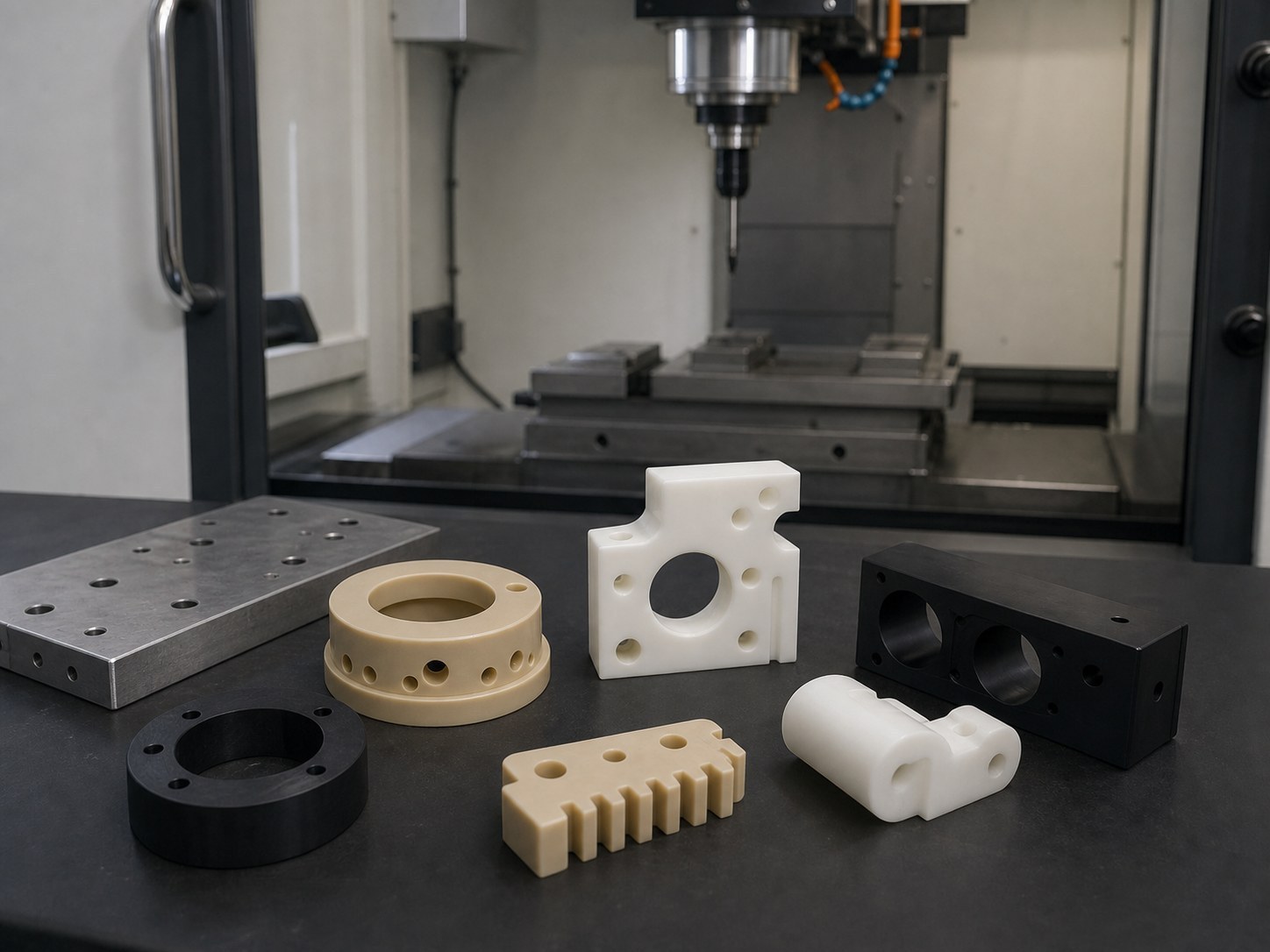
• 工程塑料非标零件置于干净加工台上的真实摄影画面,可见自然刀纹和薄壁结构,不出现文字、品牌或联系方式。
• 精密工程塑料零件在低应力软夹具中装夹的近景,突出大面积支承与分散夹紧,避免明显渲染感。
• 工程塑料零件完成加工后在洁净工作台进行尺寸复核的真实场景,不展示任何带文字的文件或屏幕。
• 所有图片均应压缩至400KB以内;配图不得使用工程图纸原图。
• ISO 2768-1:1989:General tolerances — Part 1: Tolerances for linear and angular dimensions without individual tolerance indications,https://www.iso.org/standard/7748.html
• ISO 286-1:2010:Geometrical product specifications (GPS) — ISO code system for tolerances on linear sizes — Part 1,https://www.iso.org/standard/45975.html
• ISO 1101:2017:Geometrical product specifications (GPS) — Geometrical tolerancing — Tolerances of form, orientation, location and run-out,https://www.iso.org/standard/66777.html
• ISO 21920-1:2021:Geometrical product specifications (GPS) — Surface texture: Profile — Part 1,https://www.iso.org/standard/72196.html
177-0621-7614
24小时服务热线
扫码添加微信
备注"公司+姓名"
shiziqiu@oemach.com
邮箱